
Blog
Refine Search
Furnace Insulation and Energy Efficiency: Where Does the Heat Go?

- By OEM FURNACE Mühendislik
- 13/10/2026
- 0 comments
One of the biggest factors in a furnace's energy bill is how much of the heat it produces goes into the product and how much is lost to the surroundings. A hot outer casing on an old or worn furnace shows that part of the energy is simply heating the workshop. Where does the heat go? Walls, roof and floor: conduction through insufficient or damaged insulation. Doors and lids: opening time and seal condition; radiation through an open lid is very large. Flue gas (fuel-fired furnaces): heat leaving with hot exhaust; partly recoverable by preheating combustion air with a recuperator..
How to Extend Crucible Life: From First Heat-Up to Daily Cleaning

- By OEM FURNACE Mühendislik
- 13/10/2026
- 0 comments
In crucible furnaces the crucible is both the most critical and the most frequently replaced consumable. A crucible that cracks early means not only cost but also a risk of molten-metal run-out. The good news: most factors that decide crucible life are under the plant's control. Note: every crucible manufacturer has its own first-heating and operating instructions. The points below are general principles and do not replace them. 1. Storage and handling Crucibles are sensitive to moisture. Store them dry and off the floor. Avoid knocks and rolling during handling; an invisible crack can gr..
Degassing Aluminium: Why Hydrogen Porosity Forms and How to Prevent It

- By OEM FURNACE Mühendislik
- 13/10/2026
- 0 comments
One of the most common reasons for aluminium castings failing leak tests or showing voids after machining is hydrogen porosity. Understanding its source is half the solution. Where does the hydrogen come from? Molten aluminium reacts with moisture in the air and in the charge; the released hydrogen dissolves in the melt. Hydrogen solubility in liquid aluminium is roughly 20 times higher than in solid aluminium, so during solidification the excess must leave the metal — and where it cannot escape, it forms gas pores. Main sources of moisture and hydrogen: Wet or oily scrap, chips and ..
What Are T4 and T6 Heat Treatments of Aluminium? Solution, Quench and Ageing

- By OEM FURNACE Mühendislik
- 13/10/2026
- 0 comments
Many aluminium parts — from cast wheels to automotive suspension components — only reach their required strength through heat treatment. T4 and T6 are the two most common tempers. Both apply to precipitation-hardenable alloys such as casting alloy A356 (AlSi7Mg) or 6xxx wrought alloys. 1. Solution treatment The part is held for several hours at a temperature slightly below the alloy's solidus (typically around 530–545 °C for A356) to dissolve alloying elements such as Mg and Si into the aluminium matrix. Temperature uniformity in the furnace is critical: too hot causes local melting, too c..
Tilting, Stationary or Rotary Furnace: Which Type for Which Job?

- By OEM FURNACE Mühendislik
- 13/10/2026
- 0 comments
Aluminium melting furnaces differ not only in capacity and energy source but also in how they hold and discharge the metal. The right type depends on your casting method, batch size and scrap/ingot ratio. Stationary crucible furnace The crucible is fixed and metal is taken out with a ladle. Simple design, low investment and easy maintenance make it common for gravity casting, small die-casting cells and job-shop production, typically from a few hundred kilograms up to 1 tonne. Ladling can increase operator workload and temperature loss with larger batches. Example: SMFFA stationary furnac..
Electric or Gas-Fired? 7 Criteria for Choosing an Aluminium Melting Furnace
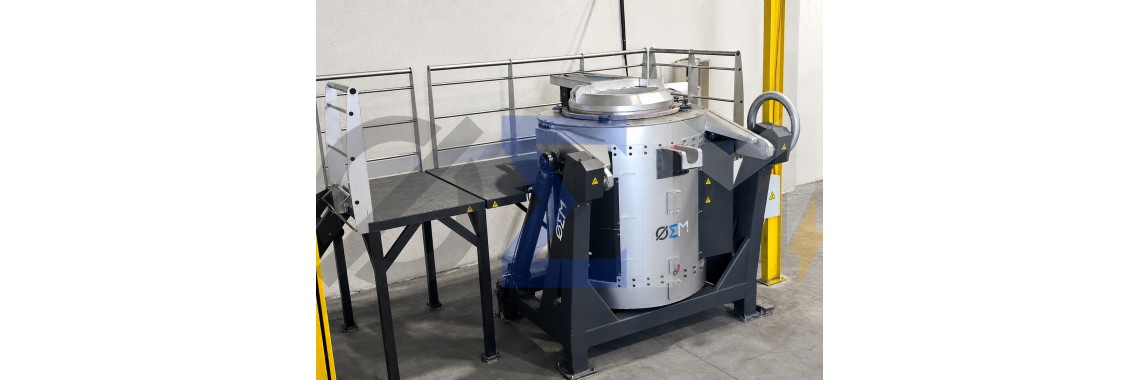
- By OEM FURNACE Mühendislik
- 30/09/2025
- 0 comments
One of the first questions when buying an aluminium melting furnace is the energy source: electric or natural gas? Both can be the right answer. The decision depends on your production pattern, site infrastructure and energy prices. These seven criteria will help you clarify your own answer before requesting a quotation. 1. How much and how often will you melt? Daily melt volume and shift pattern are the basis of the choice. Continuous lines that need a high hourly melt rate benefit from the fast heat-up and high power of gas-fired furnaces. Smaller batches, holding-heavy operation or cast..